Tuesday, February 3, 2009

Google Earth goes underwater

Google Earth dives in the sea
Google dove into the sea on Monday by releasing an updated 3-D mapping service that lets users discover the ocean as if they were dolphins, swimming past flooded volcanoes and throughout underwater canyons.

You can now dive into the world's ocean that covers almost three-quarters of the planet and discover new wonders.

Google Ocean expands this map to include large swathes of the ocean floor and abyssal plain.
Users can dive beneath a dynamic water surface to explore the 3D sea floor terrain.
The map also includes 20 content layers, containing information from the world's leading scientists, researchers, and ocean explorers.

Al Gore was at the launch event in San Francisco which, Google hopes, will take its mapping software a step closer towards total coverage of the entire globe.
In a statement, Mr Gore said that the update would make Google Earth a "magical experience".
"You can not only zoom into whatever part of our planet's surface you wish to examine in closer detail, you can now dive into the world's ocean that covers almost three-quarters of the planet and discover new wonders that had not been accessible in previous versions".
Approximately 70% of the worlds surface is covered by water and contains nearly 80% of all life, yet less than 5% of it has actually been explored.
Google Oceans aims to let users visit some of the more interesting locations, including underwater volcanoes, as well as running videos on marine life, shipwrecks and clips of favourite surf and dive spots.
The new features were developed in close collaboration with oceanographer Sylvia Earle and an advisory council of more than 25 ocean advocates and scientists.
Sylvia Earle, the National Geographic Society's explorer in residence, said the new features would bring the blue planet to life.
"I cannot imagine a more effective way to inspire awareness and caring for the blue heart of the planet than the new Ocean in Google Earth."
"For the first time, everyone from curious kids to serious researchers can see the world, the whole world, with new eyes," she added.
There are also updates on the terrestrial side, including GPS tracking, virtual time travel (where users can observe changes in satellite images, such as the 2006 World Cup stadium or the desertification of Africa's Lake Chad) and narrated tours of imagery and content in Google Earth. There are also updates to the Mars 3D section, so if users have had enough of the blue planet, they can always look at the red one.


The enhanced Google Earth, available for download at earth.google.com, offers everything from photographs and videos of sea life to models of shipwrecks to water temperature data collected from buoys. Dozens of partners - including the National Geographic Society, the National Oceanographic and Atmospheric Administration and the Scripps Oceanographic Institution - contributed information to the project, which is aimed at fostering learning, promoting conservation and, no doubt, increasing Google's popularity.
By plunging underwater, Google is adding a new dimension to Google Earth, which previously showcased only the terrestrial world. Premiered four years ago, it was probably best known as a tool for users to get a bird's-eye view of their homes and to peep on their neighbor's backyards.
The omission of the liquid two-thirds of the planet prompted Sylvia Earle, the former chief scientist at NOAA and noted oceanographer, to quip once that Google Earth should be renamed "Google dirt." On stage Monday at a Google kickoff event at San Francisco's California Academy of Sciences, she declared the enhanced version a "fantastic new rendition of the earth."
Google Earth lets you fly anywhere on Earth to view satellite imagery, maps, terrain, 3D buildings, from galaxies in outer space to the canyons of the ocean. You can explore rich geographical content, save your toured places, and share with others.

Monday, February 2, 2009

Scientists akin to Obama's environmental diagram

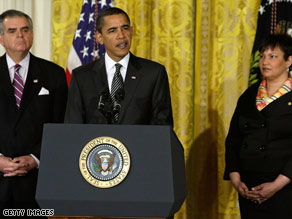
President Barack Obama with Transportation Secretary Ray LaHood and EPA Administrator Lisa Jackson
Environmentalists are encouraged by President Barack Obama's focus this week on renewable energy and stricter emissions standards, although some economists are skeptical he can pull the country out of the recession while cleaning up the planet.

Obama must strike a careful balance between stimulating the economy in the coming months and investing in the long-term future of the environment, said Raj Chetty, professor of economics at the University of California, Berkeley.
"If you spend money too quickly, you lose site of the long-term vision," Chetty told CNN. "If you focus too much on the long term, you may not act on spending money."
Framing his remarks with an eye on the recession, the president on Monday announced a plan for "a new energy economy that will build millions of jobs." Obama proposes to put 460,000 Americans to work through clean energy investments, increasing fuel efficiency in vehicles and reducing greenhouse gas emissions.
By 2025, the Obama administration hopes one-fourth of the nation's energy will come from renewable sources. Over the long term, the president hopes to create millions of new jobs by investing $150 billion in taxpayer money to help private companies develop new sources of clean energy, such as wind, solar and geothermal power.


It's about time, say scientists who often clashed with former President George W. Bush on environmental policy.

"By repowering our nation with clean energy, we will create millions of jobs that can't be sent overseas. By harnessing the energy of the sun and wind, we can refuel our nation and end our addiction to oil," said Wesley Warren, director of programs for the Natural Resources Defense Council.
Environmental scholars, however, say the changes Obama seeks are not easy.
"These technologies are not new. They have been around for 10 to 15 years," said Bill Chameides, dean of the Nicholas School of Environment at Duke University. "Government can push new policies, but it has to prove to be economically competitive or else it will not happen."
"It is going to require massive investments," said Joseph Romm, former acting assistant secretary of energy under the Clinton administration and senior fellow at the Center for American Progress. "The only question is, are we going to be the leader and export our technologies or a follower and continue importing our resources?"
Some economists question whether spending government money on new energy technologies is the best way to stimulate the economy in the short term.
Opponents of Obama's proposals say renewable energy would be expensive, take up large amounts of land, and might not even be able to generate sufficient energy given the aging infrastructure of the nation's electric grid.
"If the private sector will not invest in these technologies, it will not be efficient," said Alan Reynolds, senior fellow at the Cato Institute.
"Creating jobs by switching from one form of energy to another is a bad idea," he added. "You don't need subsidies for anything that is free. Getting a $7,000 rebate on a $100,000 plug-in electrical hybrid that gets its power from a coal plant doesn't make a lot of sense."
Several events in Washington this week underscored the Obama administration's commitment to environmental issues. Secretary of State Hillary Clinton on Monday named a special envoy to pursue global agreements combating global warming. On Wednesday, former Vice President Al Gore urged Congress to approve Obama's stimulus package and said the United States needs to join international talks on a climate-change treaty.
"For years our efforts to address the climate crisis have been undermined by the idea that we must chose between our planet and our way of life, between our moral duty and economic well-being these are false choices," Gore told the Senate Foreign Relations Committee.
"In fact, the solutions to the climate crisis are the same solutions that will address our economic and national crisis as well."
Obama may have science on his side. By overwhelming consensus, scientists agree that our warming planet poses a greater global threat with every passing day.
The replacement of current technology with energy generated from natural resources, such as sunlight and wind, could help reduce CO2 emissions by 50 percent by 2050, according to the International Energy Agency.
"Frankly the science is screaming at us," said Sen. John Kerry, chairman of the Senate Foreign Relations Committee, at Wednesday's hearing. "Carbon dioxide emissions grew at a rate of four times faster in the Bush administration than they did in the 1990s."
Even so, experts agree the faltering economy will complicate any discussion about investment in clean energy.
"The country is running two deficits," said David Orr, a professor of environmental studies and politics at Oberlin College, "the economy in the short term, which will take one to five years to figure out [and] the environment in the long term, which if we don't do anything about it will see catastrophic effects."

cybercrime is rising sharply, experts have warned at the World Economic Forum in Davos.


Cybercrime threat rising stridently.
The threat of cybercrime is rising sharply, experts have warned at the World Economic Forum in Davos.

They called for a new system to tackle well-organised gangs of cybercriminals.

Online theft costs $1 trillion a year, the number of attacks is rising sharply and too many people do not know how to protect themselves, they said.

The internet was vulnerable, they said, but as it was now part of society's central nervous system, attacks could threaten whole economies.

The past year had seen "more vulnerabilities, more cybercrime, more malicious software than ever before", more than had been seen in the past five years combined, one of the experts reported.

But does that really put "the internet at risk?", was the topic of session at the annual Davos meeting.

On the panel discussing the issue were Mozilla chairwoman Mitchell Baker (makers of the Firefox browser), McAfee chief executive Dave Dewalt, Harvard law professor and leading internet expert Jonathan Zittrain, Andre Kudelski of Kudelski group, which provides digital security solutions, and Tom Ilube, the boss of Garlik, a firm working on online web identity protection.

They were also joined by Microsoft's chief research officer, Craig Mundie.

To encourage frank debate, Davos rules do not allow the attribution of comments to individual panellists

Threat #1: Crime

The experts on the panel outlined a wide range of threats facing the internet.
There was traditional cybercrime: committing fraud or theft by stealing somebody's identity, their credit card details and other data, or tricking them into paying for services or goods that do not exist.

The majority of these crimes, one participant said, were not being committed by a youngster sitting in a basement at their computer.

Rather, they were executed by very large and very well-organised criminal gangs.

One panellist described the case of a lawyer who had realised that he could make more money though cybercrime.

He went on to assemble a gang of about 300 people with specialised roles - computer experts, lawyers, people harvesting the data etc.

Such criminals use viruses to take control of computers, combine thousands of them into so-called "botnets" that are used for concerted cyber attacks.

In the United States, a "virtual" group had managed to hijack and redirect the details of 25 million credit card transactions to Ukraine. The group used the data to buy a large number of goods, which were then sold on eBay.

This suggested organisation on a huge scale.

"This is not vandalism anymore, but organised criminality," a panellist said, while another added that "this is it is not about technology, but our economy".

Threat #2: the system

A much larger problem, though, are flaws in the set-up of the web itself.

It is organised around the principle of trust, which can have unexpected knock-on effects.

Nearly a year ago, Pakistan tried to ban a YouTube video that it deemed to be offensive to Islam.

The country's internet service providers (ISPs) were ordered to stop all YouTube traffic within Pakistan.
However, one ISP inadvertently managed to make YouTube inaccessible from anywhere in the world.

But in cyberspace, nobody is responsible for dealing with such incidents.

It fell to a loose group of volunteers to analyse the problem and distribute a patch globally within 90 minutes.

"Fortunately there was no Star Trek convention and they were all around," a panellist joked.

Threat #3: cyber warfare

Design flaws are one thing, cyber warfare is another.

Two years ago, a political dispute between Russia and Estonia escalated when the small Baltic country came under a sustained denial-of-service attack which disabled the country's banking industry and its utilities like the electricity network.
This was repeated last year, when Georgia's web infrastructure was brought down on its knees during its conflict with Russia.

"2008 was the year when cyber warfare began.. it showed that you can bring down a country within minutes," one panellist said.

"It was like cyber riot, Russia started it and then many hackers jumped on the bandwagon," said another.

This threat was now getting even greater because of the "multiplication of web-enabled devices" - from cars to fridges, from environmental sensors to digital television networks.

The panel discussed methods that terrorists could use to attack or undermine the whole internet, and posed the question whether the web would be able to survive such an assault.

The real problem, concluded one of the experts, was not the individual loss.

It was the systemic risk, where fraud and attacks undermine either trust in or the functionality of the system, to the point where it becomes unusable.


What solution?

"The problems are daunting, and it's getting worse," said one of the experts. "Do we need a true disaster to bring people together?," asked another.

One panellist noted that unlike the real world - where we know whether a certain neighbourhood is safe or not - cyberspace was still too new for most of us to make such judgements. This uncertainty created fear.

And as "the internet is a global network, it doesn't obey traditional boundaries, and traditional ways of policing don't work," one expert said.

Comparing virus-infected computers to people carrying highly infectious diseases like Sars, he proposed the creation of a World Health Organisation for the internet.

"If you have a highly communicable disease, you don't have any civil liberties at that point. We quarantine people."

"We can identify the machines that have been co-opted, that provide the energy to botnets, but right now we have no way to sequester them."

But several panellists worried about the heavy hand of government. The internet's strength was its open nature. Centralising it would be a huge threat to innovation, evolution and growth of the web.

"The amount of control required [to exclude all risk] is quite totalitarian," one of them warned.

Instead they suggested to foster the civic spirit of the web, similar to the open source software movement and the team that had sorted the YouTube problem.

"Would a formalised internet police following protocols have been able to find the [internet service provider] in Pakistan as quickly and deployed a fix that quickly?" one of them asked.

How Soon Will Cybercrimes Be Punished?
In criminal offenses, there would be no crime when there is no law punishing it. That explains why various crimes done through the internet still persist these days. In cases where the offenders are caught, court proceedings won't go so well because only the part of the offense which is governed by the Revised Penal Code (RPC) is being litigated. The main bulk of the offense, the cybercrime, is usually left untouched. This is the main issue; yet, the current RPC is still inadequate to deal with such matter. Hence, the government's highest monitoring body for the conditions and status of Information Technology in the Philippines is now putting pressure on the legislature to propose a bill against cybercrimes.
The Commission on Information and Communication Technology (CICT) define cybercrimes as those offenses done in the realm of the internet which, just like usual offenses, have grave and concrete effects to the ones who are affronted. The crimes identified are hacking, identity theft, phishing, spamming, website defacement, denial-of-service (DoS) attacks, malware or viruses, child pornography, and cyber prostitution. Such crimes are not yet punishable under the country's criminal law. That is why there is a need for a legislative action to eventually make each of the aforementioned offenses become a felony in order for perpetrators to be punished in accordance with the law.
CICT is very hopeful that increased awareness and support will push the Congress to finally pass a bill against cybercrimes. The commission endorsed the "Cybercrime Prevention Act of 2008" wherein four cyber-related bills authored by different lawmakers are consolidated. A representative from the Council of Europe, an organ of the European Council, also joined the technical working group in refining the bill a year prior to the endorsement. Such representation is meant to "harmonize" the bill with European standards on cybersecurity. It has to be considered that such crimes are not solely confined to one nation but rather that they traverse territorial boundaries considering that the crimes are committed in the World Wide Web..
Currently, CICT feels that there is an increasing support from private sector groups. The Business Process Association of the Philippines (B/PAP) which represents the outsourcing industry is an example. The said umbrella organization supports such bill because it infers that once the country is secured from different forms of cybercrimes through existing and enforceable laws, it would be easier to sell the services that are done in the country to foreign investors. The bill would ensure that the clients are well covered when we speak of cybersecurity in the Philippines.
With these, it can be said that the current conditions the country is facing calls for progressive and up-to-date legislations. Neighboring countries like Singapore and Malaysia have already adopted such measure. Unluckily though, the bill is hampered by the other so called "more important" considerations discussed in both Lower and Upper House of the Congress in the Philippines. It is already five years since the bill was endorsed, yet, the Congress still fails to accommodate it. While increased support and awareness regarding cybercrimes becomes more apparent, hopefully ,the legislature will finally act on this issue.

Microsoft patent makes smart phones like more then pc


'Smart system' includes cradle that allows smart phone to connect to peripherals, networks, through a USB connection.

Microsoft Corp. has patented smart phone-docking technology that would allow the devices to connect to peripherals and networks similar to the way PCs do.

According to a filing with the U.S. Patent and Trademark Office, Microsoft has patented a "smart system" that includes a smart-phone cradle that allows the device to interface to peripherals, networks and large video displays through a USB connection.


Some of the peripherals the cradle would allow the smart phone to link up to include printers, TV screens, cameras, external storage devices and speakers, according to the patent, which Microsoft acquired Jan. 22.

For years Microsoft executives -- particularly Chairman Bill Gates, who is no longer on full-time duty at the company -- have discussed publicly how PCs and smart devices are reaching an intersection, and how PC technology will be available in smaller devices.

The patent filing reflects this notion. "The cell phone is rapidly evolving into a smart communications device that can provide sufficient computing power and functionality to drive a wide variety of peripherals as well as access network services," according to the filing. "A major impediment to taking advantage of this evolving technology in the cell phone, for example, is the inability to connect the phone to peripheral devices and systems."

Apple Inc.'s iPhone, introduced in mid-2007, was probably the first and best example of the intersection between PCs and smart phones; it's more like a mini-PC than a mobile phone. With devices based on the Windows Mobile operating system that third parties sell, Microsoft also offers a similar hybrid of PC and smart phone.

Microsoft also released a Zune music and video player to compete with Apple's iPod, but the device has garnered only lukewarm customer interest, leaving the future of the product uncertain. Rumors swirled that Microsoft would unveil a combination Zune/Windows Mobile device to rival iPhone at the Consumer Electronics Show in Las Vegas earlier this month, but that did not happen.

Microsoft did not immediately comment on the patent Friday. The company doesn't typically comment on technologies it patents, which may or may not end up as products or as a part of products Microsoft sells.

Sunday, February 1, 2009

Scientists apply Darwin theory to develop new technologies


What drove Charles Darwin to his extraordinary ideas on evolution and human origins? Adrian Desmond, with co-author James Moore, argue in a new book that the great scientist had a "sacred cause": the abolition of slavery.

It makes one's blood boil," said Charles Darwin.
Not much outraged the gentle recluse, but the horrors of slavery could cost him a night's sleep.
He was thinking of the whipped house boy and the thumbscrews used by old ladies in South America, atrocities he had witnessed on the Beagle voyage.
The screams stayed with him for life, but how much did they influence his life's work?
Today you can still read of Darwin's "eureka" moment when he saw the Galapagos finches.
Alas, his conversion to evolution wasn't so simple, but it was much more interesting. It didn't occur in the Galapagos, but probably on his arrival home.
And new evidence suggests that Darwin's unique approach to evolution - relating all races and species by "common descent" - could have been fostered by his anti-slavery beliefs.

Development of Darwin's theory.....
The Development of Darwin's theory began with a search for explanations of contradictions in current faith based ideas, and led him to formulate his theory of evolution which was eventually published in his book On the Origin of Species, a turning point in the history of evolutionary thought.
Following the inception of Darwin's theory in 1838, he worked on explaining the species question through natural selection as his “prime hobby” in the background to his main occupation of publishing the scientific results of the Beagle voyage. Publication of his Journal and Remarks (now known as The Voyage of the Beagle) brought him success as an author. He was settling into married life, but suffered from bouts of illness and they moved to rural Down House away from the pressures of London. He discussed his theory with friends, and wrote up an essay setting out his basic ideas as well as continuing with experiments and wide investigations.
In 1846 he completed his third geological book, and turned from supervising the publication of expert reports on the findings from the voyage to examining barnacle specimens himself. This grew into an eight year study, establishing his expertise as a biologist and finding support for his theory. His treasured daughter suffered a long illness and died, shaking his dwindling faith in Christianity. In 1854 he resumed work on the species question. This would lead to the publication of Darwin's theory.
Charles Darwin became a naturalist at a point in the history of evolutionary thought when theories of Transmutation were being developed to explain discrepancies in the established faith based explanations of species. He considered these problems at first hand during the Beagle survey. On its return in 1836 his ideas developed rapidly. His collections and writings established him as an eminent geologist and collector.
Darwin read Malthus's Essay on the Principle of Population in the context of his findings about species relating to localities, enquiries into animal breeding, and ideas of Natural "laws of harmony". Around late November 1838 he related breeders selecting traits to a Malthusian Nature selecting from variants thrown up by "chance" so that "every part of newly acquired structure is fully practised and perfected", thinking this "the most beautiful part of my theory" of how species originated.
His theory of how species originated had now come together in principle, but he was vividly aware of the difficulties he would face in getting it accepted by his friends and colleagues in the scientific establishment. On 19 December 1838 as secretary of the Geological Society of London Darwin witnessed the vicious interrogation by Richard Owen and his allies of Darwin's old tutor Robert Edmund Grant in which they ridiculed Grant's Lamarckian heresy, showing establishment intolerance of materialist theories.

Darwin theory to develop new technologies......
Still a flash point among fundamentalist Christians, the theory of evolution proposed by Charles Darwin 150 years ago has become an indispensable tool for biologists to comprehend the natural world.
Yet as scientists mark Darwin’s 200th birthday this month, evolution is no longer simply a narrative of life. Scientists have begun using it as a tool to develop new technologies.
By doing so, they have improved law enforcement, created smarter computer programs and are remaking the field of medicine. There have been quirkier applications, such as cleaner clothes, too.
Only recently, though, have scientists begun calling attention to these breakthroughs, as the ideas of the iconic English naturalist have faced renewed attacks.
In Texas, controversy over Darwin’s work resurfaced last month when the State Board of Education narrowly voted to delete a provision that required the teaching of the weaknesses and strengths of evolutionary theory. The board is to act soon on a proposal that would require students to consider the evolutionary principle that all organisms have a common ancestor. Supporters say they want children to understand there are viable alternatives to evolution.
But Andy Ellington, a University of Texas evolutionary biologist, called that argument “almost amusing.”
“You have these folks who are trying to suggest that we shouldn’t teach evolution as something our kids need to know,” he said. “But at the same time, there are these new technologies out there shaping our lives every day.”
Darwin, born Feb. 12, 1809, sailed from England in 1831 on a five-year voyage around the world. During the journey, he took copious notes about the variability of flora and fauna.
Darwin’s observations in A Naturalist’s Voyage Around the World eventually led to the notions of natural selection and evolution, theories he laid out in On the Origin of Species, the 150th anniversary of which comes in December.
Thanks to the discovery of DNA’s structure in 1953 and the mapping of the human genome half a century later, biologists now say they understand the mechanisms by which genes mutate and species evolve. And they’re using that knowledge in increasingly powerful ways.
One of the first and most well-known uses of evolutionary theory has come in law enforcement.
Among the 3 billion or so chemical bits, or letters, in human DNA are those that change slowly and those that mutate rapidly. Scientists realized that short segments of DNA vary greatly from person to person as a result. The finding gave rise to the concept of DNA fingerprints to identify individuals.
Crime-fighting, medicineBy the late 1980s, scientists were testifying in court about the reliability of DNA evidence to convict criminals. Such evidence has become a powerful forensic tool.
“It’s had a tremendous impact on criminal justice, not the least of which has been to free a lot of innocent people,” said Rusty Hardin, now a defense lawyer who in 1988 prosecuted the first Harris County case that used DNA evidence.
In recent years, the concept of genetic identification has been extended to such areas as vintage wines and Beluga caviar, where buyers want surety that what they’re buying is authentic.
Evolution also has helped scientists become smarter about the development and use of medicines such as antibiotics and vaccines.
Physicians now understand that bacteria mutate over time. When attacked by antibiotics, some bacteria become resistant to certain antibiotics and thrive.
“Evolutionary theory has definitely guided us, and now we as a medical community know to be much more careful about the use of antibiotics,” said Dr. James Versalovic, a Baylor College of Medicine professor and the director of microbiology at Texas Children’s Hospital.
The evolution of viruses also is critical to the development of vaccines. Some viruses, such as polio, have genetic material that changes slowly over time, allowing physicians to create a vaccine that will last for life.
Other viruses, including influenza and HIV, are constantly changing. This requires annual changes to the flu vaccine and has prevented development of a successful vaccine against HIV.
“We know we are in a world where we are in a constant competition with bacteria and viruses,” said Dan Graur, a University of Houston biologist. “We need to use evolutionary principles just to keep them under control.”
Some scientists also use evolution to develop drugs to combat disease, an approach called “directed evolution.”
Biologists employing this method generate a large batch of random segments of DNA — short strips of biological material — which are then tested to see whether any will perform a useful function inside cells, such as binding to a protein. The DNA segments that fail at the task are eliminated; those that succeed are copied in such a way that new mutations are introduced. These new variants then are tested. The process is replicated many times until an optimal sequence is found.
Computer programsThe approach has led to treatments for an eye disease called wet macular degeneration and other diseases, said Ellington, the UT-Austin biologist whose lab conducts directed evolution experiments.
Computer scientists use a similar process, called evolutionary or genetic algorithms. This technique involves many people writing computer programs for a certain task, such as managing air traffic or weather forecasting. Just as members of a species compete for resources in the wild, the programs compete with one another, mixing and matching lines of code and ultimately producing the most efficient algorithm for a certain task.
A company called Maxygen has applied this process to basic household goods.
Enzymes help speed up chemical reactions and are often good at digesting fats, starches and proteins — the kinds of materials that stain clothes. Maxygen collected enzymes from different bacteria, chopped and mixed them, and created new enzymes
.

Friday, January 30, 2009

Solar power a ventilation system that can cool the car without help from the engine.


Solar cars still a way off

Toyota's third-generation Prius, due at dealerships this spring, will have an optional solar panel on its roof. The panel will power a ventilation system that can cool the car without help from the engine, Toyota says.
But it's a long way from the 2010 Prius to a solar-powered car, experts told CNN. Most agree that there just isn't enough space on a production car to get full power from solar panels.

"Being able to power a car entirely with solar is a pretty far-reaching goal," said Tony Markel, a senior engineer at the federal government's National Renewable Energy Lab in Golden, Colorado.


In the new Prius, the solar panel will provide energy for a ventilation fan that will help cool the parked car on sunny, hot days. The driver can start the fan remotely before stepping into the car. Once the car is started, the air conditioning won't need as much energy from a battery to do the rest of the cooling.


"The best thing about using solar is that regardless of what you end up using it for, you're trying to use it to displace gasoline," added Markel.


The question is, how much gasoline can solar power offset? Markel said his lab has modified a Prius to use electricity from the grid for its main batteries and a solar panel for the auxiliary systems. He believes the car gets an additional 5 miles of electric range from the panel.
According to recent articles in Japan's Nikkei newspaper, Toyota has bigger plans for harnessing power from the sun. Nikkei reports that Toyota hopes to develop a vehicle powered entirely by solar panels. The project will take years, the paper reported.


When contacted by CNN, however, a Toyota spokeswoman denied the existence of the project.


"At this time there are no plans that we know of to produce a concept or production version of a solar-powered car," said Amy K. Taylor, a communications administrator in Toyota's Environmental, Safety & Quality division.


Motorists don't have to wait for a 2010 Prius to drive a solar-enhanced car, however. Greg Johanson, president of Solar Electric Vehicles in Westlake Village, California, said his company makes a roof-mounted panel for a standard Prius that enables the car to travel up to 15 additional miles a day.


The system costs $3,500, and it takes about a week to make one, Johanson said. Billy Bautista, a project coordinator at the company, said Solar Electric Vehicles gets so many requests for the system that there is a backlog of several months.


The company's Web site says motorists can install the panels themselves, although it recommends finding a "qualified technician."


The system delivers about 165 watts of power per hour to an added battery, which helps powers the electric motor, Johanson said.


But others said it would take a lot more power than that to replace an internal combustion engine.


Eric Leonhardt, director of the Vehicle Research Institute at Western Washington University, said that even if solar cells worked far better than they do today, they wouldn't generate enough power for driving substantial distances. The best cells operate at about 33 percent efficiency, but the ones used on vehicles are only about 18 percent efficient, he said.


Leonhardt said it would be more practical to use solar power to help charge a car's battery and use the more efficient panels mounted on a roof or over a parking area to supply the rest of the electricity needed to drive the engine.


"Solar panels really need a lot of area," he said.


Leonhardt thinks Toyota's new Prius is a good first step toward using renewable energy. Some cars get hotter than 150 degrees inside when parked in the sun, so reducing the temperature could mean Toyota could use a smaller AC unit, he added.


Johanson of Solar Electric Vehicles said he'd like to see Toyota bring the weight of a Prius down from 3,000 pounds to 2,000. He also hopes for a small gasoline engine and a larger electric motor. That will probably come in the future, when Toyota unveils a plug-in engine.


In the meantime, Solar Electric Vehicles sells its version of a plug-in Prius, with a solar panel installed, for $25,000, Bautista said.


Toyota is the largest automaker to incorporate solar power into a mass-produced car. But its solar panel is not the first for a car company. Audi uses one on its upscale A8 model, and Mazda tried one on its 929 in the 1990s.


In addition, a French motor company, Venturi, has produced an electric-solar hybrid. The Eclectic model costs $30,000, looks like a souped-up golf cart and uses roof-mounted solar panels to help power an electric engine. It has a range of about 30 miles and has a top speed of about 30 mph.


ABOUT Solar vehicle


Borealis III leads the way during the 2005 North American Solar Challenge passing by Lake Benton, Minnesota.A solar vehicle is an electric vehicle powered by a type of renewable energy, by solar energy obtained from solar panels on the surface (generally, the roof) of the vehicle. Photovoltaic (PV) cells convert the Sun's energy directly into electrical energy. Solar vehicles are not practical day-to-day transportation devices at present, but are primarily demonstration vehicles and engineering exercises, often sponsored by government agencies.


Solar cars
Solar cars combine technology typically used in the aerospace, bicycle, alternative energy and automotive industries. The design of a solar vehicle is severely limited by the energy input into the car (batteries and power from the sun). Virtually all solar cars ever built have been for the purpose of solar car races (with notable exceptions).


Like many race cars, the driver's cockpit usually only contains room for one person, although a few cars do contain room for a second passenger. They contain some of the features available to drivers of traditional vehicles such as brakes, accelerator, turn signals, rear view mirrors (or camera), ventilation, and sometimes cruise control. A radio for communication with their support crews is almost always included.


Solar cars are often fitted with gauges as seen in conventional cars. Aside from keeping the car on the road, the driver's main priority is to keep an eye on these gauges to spot possible problems. Cars without gauges available for the driver will almost always feature wireless telemetry. Wireless telemetry allows the driver's team to monitor the car's energy consumption, solar energy capture and other parameters and free the driver to concentrate on just driving.


Electrical and mechanical systems
The electrical system is the most important part of the car's systems as it controls all of the power that comes into and leaves the system. The battery pack plays the same role in a solar car that a petrol tank plays in a normal car in storing power for future use. Solar cars use a range of batteries including lead-acid batteries, nickel-metal hydride batteries (NiMH), Nickel-Cadmium batteries (NiCd), Lithium ion batteries and Lithium polymer batteries.


Many solar race cars have complex data acquisition systems that monitor the whole electrical system while even the most basic cars have systems that provide information on battery voltage and current to the driver.


The mechanical systems of a solar car are designed to keep friction and weight to a minimum while maintaining strength. Designers normally use titanium and composites to ensure a good strength-to-weight ratio.


Solar cars usually have three wheels, but some have four. Three wheelers usually have two front wheels and one rear wheel: the front wheels steer and the rear wheel follows. Four wheel vehicles are set up like normal cars or similarly to three wheeled vehicles with the two rear wheels close together.

Technorati : , , , , , , ,

Thursday, January 29, 2009

Google's new online tools that will diagnose your network connection & performance.l

Google and a group of partners have released a set of tools designed to help broadband customers and researchers measure performance of Internet connections.
The set of tools, at MeasurementLab.net, includes a network diagnostic tool, a network path diagnostic tool and a tool to measure whether the user's broadband provider is slowing BitTorrent peer-to-peer (P-to-P) traffic. Coming soon to the M-Lab applications is a tool to determine whether a broadband provider is giving some traffic a lower priority than other traffic, and a tool to determine whether a provider is degrading certain users or applications.


Think your Internet Service Provider (ISP) is messing with your connection performance? Now you can find out, with Google's new online tools that will diagnose your network connection.
Here's a quick walkthrough on how to make the best of them.
Google's broadband test tools are located at Measurementlab.net. On that page, you'll see an first icon that says "Users: Test Your Internet Connection". Click that, and then you'll be taken to a page where there are three tests available, and two more listed as coming soon. However, out of the three available tests, only one of them is fully automated and easy to use.
Glasnost , second on the list, will check whether your ISP is slowing down (like Comcast) or blocking Peer2Peer (P2P) downloads from software such as BitTorrent. P2P apps are commonly used for downloading illegal software and media content like movies and music, but also are used for legal purposes as well, such as distributing large software packages to many users at once.
To use the measurement tool, you will be redirected to the Glasnost site. You'll need the latest version of Java installed, and you should stop any large downloads that you may have running before you begin the test. If you're on a Mac, a popup message will prompt you to trust the site's Java applet.
When you're ready to start, you can choose whether you want to run a full test (approximately 7 minutes long) or a simple test (4 minutes long). When I tried to test my connection, Glasnost's measurement servers were overloaded and an alternative server was offered, but that was overloaded as well. After a short while I was able to run the test.
In the tests of my connection (my provider is Vodafone At Home, in the UK) all results indicated that BitTorrent traffic is not blocked or throttled. But I'm looking forward to hearing from you in the comments how your ISP performed in Glasnost's diagnostics. Meanwhile, make sure you keep an eye on the other tests that will be available soon from Measurementlab.net.