Showing posts with label Flying Technology news. Show all posts

Monday, April 27, 2009

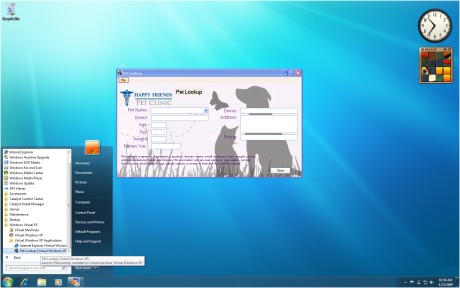
Microsoft is adding a "Windows XP Mode" to Windows 7


Now Windows 7 gets built in XP mode..
Microsoft is adding a "Windows XP Mode" to Windows 7, in a move to encourage users to make the switch to the software vendor's forthcoming operating system.

The firm has built its XP mode into Windows 7 by using the Windows Virtual PC technology Microsoft acquired in 2003, to make the OS compatible to run apps designed for Vista's predecessor.
Redmond was keen to emphasise in a blog post late on Friday that it's hoping to woo small businesses to move to Windows 7 by bigging up the XP mode feature.

"Windows XP Mode is specifically designed to help small businesses move to Windows 7," said Microsoft. "Windows XP Mode provides you with the flexibility to run many older productivity applications on a Windows 7 based PC."

Users can install apps directly into the virtualised XP environment. The applications are then published to the Windows 7 desktop and they can be run from within that OS.

Microsoft said it will release a beta of Windows XP mode and Windows Virtual PC for Windows 7 Professional and Windows 7 Ultimate "soon" but wasn't more specific about when the test builds will land.

When Microsoft released Vista over two years ago, many businesses and individuals complained about compatibility snafus with applications that simply wouldn't work within the new OS

Saturday, February 7, 2009

UK developing a low-cost rocket capable of putting small satellites in orbit.

Plans for UK satellite launcher
Virgin Galactic is not only looking to put space tourists into orbit but satellites as well, with the company joining forces with another UK firm to come up with a cheaper way to launch the devices.
Along with Surrey Satellite Technology (SSTL), Virgin Galactic will look to use a system that is comparable to the United States' Pegasus system – launching satellites into orbit from a plane.
The idea is that the same transport that takes the tourists – WhiteKnightTwo – could serve as the platform to put satellites into orbit for a fraction of the current cost.
Cheaper
"Hopefully we can do it for a lot less money than the current providers," SSTL's Dr Adam Baker
told PA.
"It costs something like five million to 10 million dollars at the moment to get one of our smaller satellites into space. What we are targeting is to see if we can do this for a million dollars.
"I think that's a very challenging number but I'm confident we can get very close to that - and if you could build the satellite itself for a couple of million dollars, all of a sudden you've got a very attractive package for well under five million dollars that lets your customers do something pretty capable in orbit."


The idea is being promoted by SSTL, a firm in Guildford, Surrey, best known for its Earth observation spacecraft, in conjunction with Virgin Galactic.
It is 38 years since the UK government abandoned its successful satellite launcher programme, Black Arrow.
The new venture would be an entirely commercial exercise.
It would see a two-stage rocket launch from underneath a carrier aircraft.
The concept would look similar to the US Pegasus system, which uses a former airliner to lift a booster to 40,000ft, before releasing it to make its own way into orbit.

"In 1971, we cancelled our launch-vehicle programme and have never gone back into it despite the fact that launch vehicles are an essential part of a healthy space industry," said Adam Baker from SSTL (Surrey Satellite Technology Limited).
"If we had our own launcher - something modest, not an enormous vehicle - for a reasonable price, we could service our own needs, both scientific and military, and we could also sell the service on the open market."
SSTL's ideas are being developed with Virgin Galactic, the company set up by billionaire Sir Richard Branson to take fare-paying passengers on short, weightless hops above the atmosphere.
Galactic has a carrier aeroplane, known as White Knight Two. Its primary function will be to lift the space tourists' rocket plane to its launch altitude.
But Galactic also wants to pursue other uses for the White Knight craft, and the idea of using it as a platform to release a British satellite launcher is an appealing one.

"The Black Arrow decision was a tragedy," said Will Whitehorn, the president of Virgin Galactic.
"It was based on a then civil service that thought there wasn't going to be a market. They were wrong."
SSTL and Virgin Galactic are hoping to get the backing of the UK science and innovation minister, Lord Drayson, in trying to see if there is interest in government in helping to fund a short feasibility study.
But any launcher system that did eventually emerge would be a commercial service, not a government operation.

SSTL envisages a vehicle capable of taking at least 50kg of payload into a polar orbit with a minimum altitude of 400km (248 miles), but engineers would aim to get significant additional performance.
"We'd be looking at a range from 50 to up to a maximum of 200kg because you'd want to do different sizes of satellite," said Mr Whitehorn.
Dr Baker added: "Hopefully we can do it for a lot less money than the current providers.
"It costs something like $5m-$10m at the moment to get one of our smaller satellites into space. What we are targeting is to see if we can do this for a million dollars.
"I think that's a very challenging number but I'm confident we can get very close to that - and if you could build the satellite itself for a couple of million dollars, all of a sudden you've got a very attractive package for well under $5m that lets your customers do something pretty capable in orbit."
Dr Baker is convinced all the expertise - in composite structures, guidance and avionics, propulsion, etc - exists in the UK to make it happen, but a study would have to prove the technical case and a viable business model.
Although a number of other groups in the UK have pursued a satellite launcher capability, the pedigree of SSTL and Virgin Galactic is likely to make potential investors sit up and take notice.
'Live' science
SSTL is perhaps best known for its Disaster Monitoring Constellation satellites which map the Earth at times of emergency at resolutions between 4m and 32m.
It also produced Giove-A, the first demonstration spacecraft for Europe's forthcoming sat-nav system, Galileo.
SSTL is owned by EADS Astrium, Europe's biggest space company. Astrium is the prime contractor on the mighty Ariane 5 rocket, which lofts some of the biggest satellites in the world.
Virgin Galactic has yet to start its space tourism service. It unveiled White Knight Two last year, and expects to roll out its tourist spaceliner, SpaceShipTwo, later this year.
Mr Whitehorn said the rocket plane also had great potential for doing microgravity research.
"You could take scientists up instead of space tourists and they could conduct their experiments 'live' in the period of microgravity you get on SpaceShipTwo, which is greater than you can get currently with zero-G aircraft.
"And of course you would have the scientists there in a way you couldn't with a sounding rocket, for example."

Monday, February 2, 2009

Scientists akin to Obama's environmental diagram

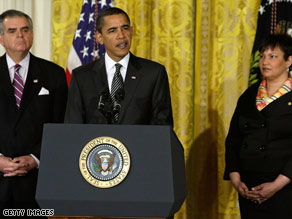
President Barack Obama with Transportation Secretary Ray LaHood and EPA Administrator Lisa Jackson
Environmentalists are encouraged by President Barack Obama's focus this week on renewable energy and stricter emissions standards, although some economists are skeptical he can pull the country out of the recession while cleaning up the planet.

Obama must strike a careful balance between stimulating the economy in the coming months and investing in the long-term future of the environment, said Raj Chetty, professor of economics at the University of California, Berkeley.
"If you spend money too quickly, you lose site of the long-term vision," Chetty told CNN. "If you focus too much on the long term, you may not act on spending money."
Framing his remarks with an eye on the recession, the president on Monday announced a plan for "a new energy economy that will build millions of jobs." Obama proposes to put 460,000 Americans to work through clean energy investments, increasing fuel efficiency in vehicles and reducing greenhouse gas emissions.
By 2025, the Obama administration hopes one-fourth of the nation's energy will come from renewable sources. Over the long term, the president hopes to create millions of new jobs by investing $150 billion in taxpayer money to help private companies develop new sources of clean energy, such as wind, solar and geothermal power.


It's about time, say scientists who often clashed with former President George W. Bush on environmental policy.

"By repowering our nation with clean energy, we will create millions of jobs that can't be sent overseas. By harnessing the energy of the sun and wind, we can refuel our nation and end our addiction to oil," said Wesley Warren, director of programs for the Natural Resources Defense Council.
Environmental scholars, however, say the changes Obama seeks are not easy.
"These technologies are not new. They have been around for 10 to 15 years," said Bill Chameides, dean of the Nicholas School of Environment at Duke University. "Government can push new policies, but it has to prove to be economically competitive or else it will not happen."
"It is going to require massive investments," said Joseph Romm, former acting assistant secretary of energy under the Clinton administration and senior fellow at the Center for American Progress. "The only question is, are we going to be the leader and export our technologies or a follower and continue importing our resources?"
Some economists question whether spending government money on new energy technologies is the best way to stimulate the economy in the short term.
Opponents of Obama's proposals say renewable energy would be expensive, take up large amounts of land, and might not even be able to generate sufficient energy given the aging infrastructure of the nation's electric grid.
"If the private sector will not invest in these technologies, it will not be efficient," said Alan Reynolds, senior fellow at the Cato Institute.
"Creating jobs by switching from one form of energy to another is a bad idea," he added. "You don't need subsidies for anything that is free. Getting a $7,000 rebate on a $100,000 plug-in electrical hybrid that gets its power from a coal plant doesn't make a lot of sense."
Several events in Washington this week underscored the Obama administration's commitment to environmental issues. Secretary of State Hillary Clinton on Monday named a special envoy to pursue global agreements combating global warming. On Wednesday, former Vice President Al Gore urged Congress to approve Obama's stimulus package and said the United States needs to join international talks on a climate-change treaty.
"For years our efforts to address the climate crisis have been undermined by the idea that we must chose between our planet and our way of life, between our moral duty and economic well-being these are false choices," Gore told the Senate Foreign Relations Committee.
"In fact, the solutions to the climate crisis are the same solutions that will address our economic and national crisis as well."
Obama may have science on his side. By overwhelming consensus, scientists agree that our warming planet poses a greater global threat with every passing day.
The replacement of current technology with energy generated from natural resources, such as sunlight and wind, could help reduce CO2 emissions by 50 percent by 2050, according to the International Energy Agency.
"Frankly the science is screaming at us," said Sen. John Kerry, chairman of the Senate Foreign Relations Committee, at Wednesday's hearing. "Carbon dioxide emissions grew at a rate of four times faster in the Bush administration than they did in the 1990s."
Even so, experts agree the faltering economy will complicate any discussion about investment in clean energy.
"The country is running two deficits," said David Orr, a professor of environmental studies and politics at Oberlin College, "the economy in the short term, which will take one to five years to figure out [and] the environment in the long term, which if we don't do anything about it will see catastrophic effects."

Thursday, January 29, 2009

Google's new online tools that will diagnose your network connection & performance.l

Google and a group of partners have released a set of tools designed to help broadband customers and researchers measure performance of Internet connections.
The set of tools, at MeasurementLab.net, includes a network diagnostic tool, a network path diagnostic tool and a tool to measure whether the user's broadband provider is slowing BitTorrent peer-to-peer (P-to-P) traffic. Coming soon to the M-Lab applications is a tool to determine whether a broadband provider is giving some traffic a lower priority than other traffic, and a tool to determine whether a provider is degrading certain users or applications.


Think your Internet Service Provider (ISP) is messing with your connection performance? Now you can find out, with Google's new online tools that will diagnose your network connection.
Here's a quick walkthrough on how to make the best of them.
Google's broadband test tools are located at Measurementlab.net. On that page, you'll see an first icon that says "Users: Test Your Internet Connection". Click that, and then you'll be taken to a page where there are three tests available, and two more listed as coming soon. However, out of the three available tests, only one of them is fully automated and easy to use.
Glasnost , second on the list, will check whether your ISP is slowing down (like Comcast) or blocking Peer2Peer (P2P) downloads from software such as BitTorrent. P2P apps are commonly used for downloading illegal software and media content like movies and music, but also are used for legal purposes as well, such as distributing large software packages to many users at once.
To use the measurement tool, you will be redirected to the Glasnost site. You'll need the latest version of Java installed, and you should stop any large downloads that you may have running before you begin the test. If you're on a Mac, a popup message will prompt you to trust the site's Java applet.
When you're ready to start, you can choose whether you want to run a full test (approximately 7 minutes long) or a simple test (4 minutes long). When I tried to test my connection, Glasnost's measurement servers were overloaded and an alternative server was offered, but that was overloaded as well. After a short while I was able to run the test.
In the tests of my connection (my provider is Vodafone At Home, in the UK) all results indicated that BitTorrent traffic is not blocked or throttled. But I'm looking forward to hearing from you in the comments how your ISP performed in Glasnost's diagnostics. Meanwhile, make sure you keep an eye on the other tests that will be available soon from Measurementlab.net.

Tuesday, January 27, 2009

UCLA researchers have reprogrammed human induced pluripotent stem cells

For the first time, UCLA researchers have reprogrammed human induced pluripotent stem (iPS) cells into the cells that finally become eggs and sperm, possibly opening the door for new treatments for sterility using patient-specific cel
The iPS cells were coaxed into forming germ line precursor cells which include genetic material that may be passed on to a child. The study appears today in the early online edition of the peer-reviewed journal Stem Cells.
“This finding could be important for people who are rendered infertile through disease or injury. We may, one day, be able to replace the germ cells that are lost,” said Amander Clark, a Broad Stem Cell Research Center scientist and senior author of the study. “And these germ cells would be specific and genetically related to that patient.”
Theoretically, an infertile patient’s skin cells, for example, could be taken and reprogrammed into iPS cells, which, like embryonic stem cells, have the ability to become every cell type in the human body. Those cells could then be transformed into germ line precursor cells that would eventually become eggs and sperm. Clark cautioned, however, that scientists are still many years from using these cells in patients to treat infertility. There is still much to be learned about the process of making high quality germ cells in the lab.In another important finding, Clark’s team discovered that the germ line cells generated from human iPS cells were not the same as the germ line cells derived from human embryonic stem cells. Certain vital regulatory processes were not performed correctly in the human iPS derived germ cells, said Clark, an assistant professor of molecular, cell and developmental biology.
So it’s crucial, Clark contends, that work continue on the more controversial human embryonic stem cells that come from donated, excess material from in vitro fertilization that would otherwise be destroyed.
When germ cells are formed, they need to undergo a specific series of biological processes, an essential one being the regulation of imprinted genes. This is required for the germ cells to function correctly. If these processes are not performed the resulting eggs or sperm, are at high risk for not working as they should. This has significant consequences, given that the desired outcome is a healthy child.
“Further research is needed to determine if germ line cells derived from iPS cells, particularly those which have not been created by retroviral integration, have the ability to correctly regulate themselves like the cells derived from human embryonic stem cells do,” Clark said. “When we looked at the germ cells derived from embryonic stem cells, we found that they regulated as expected, whereas those from the iPS cells were not regulated in the same way. We need to do much more work on this to find out why.”
Humanitarian goals, science get new life
PRESIDENT Obama's inauguration has led to the resumption of aid to international groups that perform or give information about abortions and should open the door to important scientific research. Both developments are a boost to humanitarian and medical advances that should expand during the Obama administration.
The new president signed an executive order on Friday that ended the ban on giving taxpayer money to international family groups that offer abortions or provide related information. The assistance was available from the Agency for International Development during the Clinton administration but banned during the Reagan and both Bush administrations.
Obama also is expected to restore funding for the U.N. Population Fund, which George W. Bush had rejected on the contention that it supported a Chinese family planning policy of coercive abortion and involuntary sterilization, an allegation that the agency vehemently denied. In fact, the lifting of the bans will reduce unintended pregnancies, abortions and the deaths of women from high-risk pregnancies.
The signing came a day after the Food and Drug Administration allowed the world's first clinical trial of a treatment derived from human embryonic stem cells for spinal cord injury. The therapy uses an old embryonic stem cell line that was allowed under the latest Bush administration but the approval might have been delayed until Bush left office.
The Bush administration restricted federal financing for embryonic stem cell research because creation of the cells entailed destruction of human embryos, even though they had been destined for the trash. President Obama has pledged to remove some of the financial restrictions.


Research on stem cells is the subject of intense investigation, both from a basic science point of view, as well as a basis for cell-based therapies to treat disease. The ability to study and characterize stem cells has been aided by the identification of specific markers which allow researchers to characterize and enrich these cells. The use of immunophenotyping is an important technique to distinguish one population of cells from another. eBioscience is dedicated to providing you with a choice of innovative primary antibody reagents and flurochromes to accelerate your stem cell research using multicolor flow cytometry.

Thursday, October 25, 2007

LHC( Large Hadron Collider) :ATLAS 
big wheel triumph


LHC ( Large Hadron Collider)
ATLAS celebrates installing the last of the eight big wheels. These wheels form the end-cap muon spectrometer of the detector.
The ATLAS end-cap muon detectors, the ‘big wheels’, have been compared to many things: flowers, orange halves, clock faces and works of art. But, more importantly, each is an incredible feat of engineering. On Friday last week the team celebrated the completion of the last wheel, and moved into the final stages of installation.

"I must admit that at the end of last year I would not have believed that we would manage to install these eight big wheels essentially on schedule," admitted Peter Jenni, ATLAS spokesperson. The first of the wheels took a long time to install, but the last one took just a couple of weeks. "This is really a great achievement."

The big wheels harbour ATLAS’s middle layer of muon chambers in the forward region and are one of the last large pieces to be installed. Each is 25m across, weighs between 40 and 50 tonnes and contains around 80 precision chambers or 200 trigger chambers. The support structure itself is just one third of the weight of the total wheel.

Because of their sheer size, each wheel had to be made in 12 pieces for the trigger planes and 16 pieces for the precision-measurement planes, or "petals", of aluminium, the last of which was installed on Friday. Each was assembled at CERN using components from all over the world before being fitted together, piece by piece like a jigsaw.

Because of the need for space for the chambers, designing a suitable structure presented a unique challenge, one that project engineers, Raphaël Vuillermet, Dimitar Mladenov and Giancarlo Spigo were happy to take on.

"The detectors themselves have been on drawings for 15 years; everyone knew where they would go but no one knew about the structure," explains Dimitar. "There were chambers everywhere so our design had to build around them and in the small spaces in between them."

The result after 3 years of calculation, design and sleepless nights was a uniquely thin and light structure that is precise to less than a millimetre.

The 100-member collaboration from Israel, Japan, the US, China, Russia, Europe and Pakistan began assembly of components in 2005 and installation in 2006. "Because the pieces are so delicate we had to be careful throughout the whole process," explains Raphaël. "I was very afraid about something happening to the chambers and also to the people, because you are working 30 metres up. But we didn’t have any problems."

The completion of the big wheels is symbolic for ATLAS because, as technical coordinator Marzio Nessi explains, "the big wheels were always seen as something we would do at the end. And now we have done them."

For Dimitar the biggest challenge was the timing. "I feel proud, but not for myself, for everyone. It was the result of hard work. The only thing that we were lucky about was the weather; if there had been a single day of heavy rain we might have been delayed. But Marzio said not to worry and to leave the weather to him, and the weather was great. I don’t know how he did it!"

Now just two smaller scale wheels and the end-wall chambers remain to be installed, and the big wheels have already begun to give read-outs as part of test runs using cosmic ray data that ATLAS performs every six weeks.

With their striking symmetry and aesthetic appeal the big wheels are likely to become icons of the experiment. But to Marzio, all pieces of ATLAS are beautiful. "This piece just happens to be 25m high."
Tuesday, July 24, 2007

Experts have recreated the final, fateful moments leading up to last year's Black Hawk helicopter crash off Fiji.


Defence department experts have recreated the final, fateful moments leading up to last year's Black Hawk helicopter crash off Fiji.
It emerged at the Sydney military board of inquiry into the crash that given the conditions of the helicopter's approach to land on HMAS Kanimbla, there was insufficient power to slow its descent and lessen its impact with the warship.
Through a combination of 3D computer modelling, helicopter simulator trials and the analysis of the Black Hawk's flight data recorder (FDR), experts also were able to rule out engine failure as a cause of the crash.
The expert witnesses from the Defence Science and Technology Organisation (DSTO) gave evidence as part of the inquiry into how the helicopter failed to negotiate a landing on the deck of the Kanimbla and plunged into the sea last November.
The pilot, Captain Mark Bingley, and SAS Trooper Joshua Porter were killed when the aircraft crashed during practice for evacuations from coup-stricken Fiji.
Helicopter simulation expert Sylvain Manso talked the board through footage of two of the army's top pilots undertaking simulator runs recreating the ill-fated manoeuvre attempted by Capt Bingley.
Those that most closely followed Capt Bingley's route found it had resulted in "unrecoverable descent rate", Mr Manso told the board.
"There was insufficient available power to recover from the flight conditions from the defined ingress," Mr Manso said.
Video footage from a security camera aboard the Kanimbla allowed experts in photogrammetry, which is the science of measuring object position using images, to plot much of the Black Hawk's approach.
Another DSTO expert, Thuan Truong, brought to life an analysis of data from the FDR, retrieved from the helicopter wreckage.
Through a series of graphs depicting flight data recorded as frequently as eight times per second, Mr Truong was able to show how Capt Bingley desperately pulled hard on the control stick in a bid to raise the nose in the last two seconds before the crash.
The graphs also revealed how Capt Bingley frantically pumped the helicopter's right pedal as he tried to correct its course.
The FDR data also gave further weight to the role of "rotor droop", where the main rotor loses power, in causing the crash.
Although no data was recorded for the main rotor, Mr Truong said data showing how power to the tail rotor plummeted to 75 per cent could be applied with reasonable accuracy to the main rotor.
"There was a tremendous reduction of aircraft lift, at 75 per cent rpm (rotor speed) the aircraft lift is approximately half its weight," Mr Truong said.
Helicopter structure engineer Dominigo Lombardo said he had inspected the salvaged wreckage of the Black Hawk and found no evidence of engine failure.
"There was nothing that stood out as being unusual," he said.
The evidence from the FDR and simulator runs also ruled out engine failure.
The inquiry continues on Tuesday.